

Informacje o twórcy.
Widok


Talkior-ofI72G6h
Subskrybować
Utworzono: 09/16/2024 18:46


Info.
Widok
Utworzono: 09/16/2024 18:46
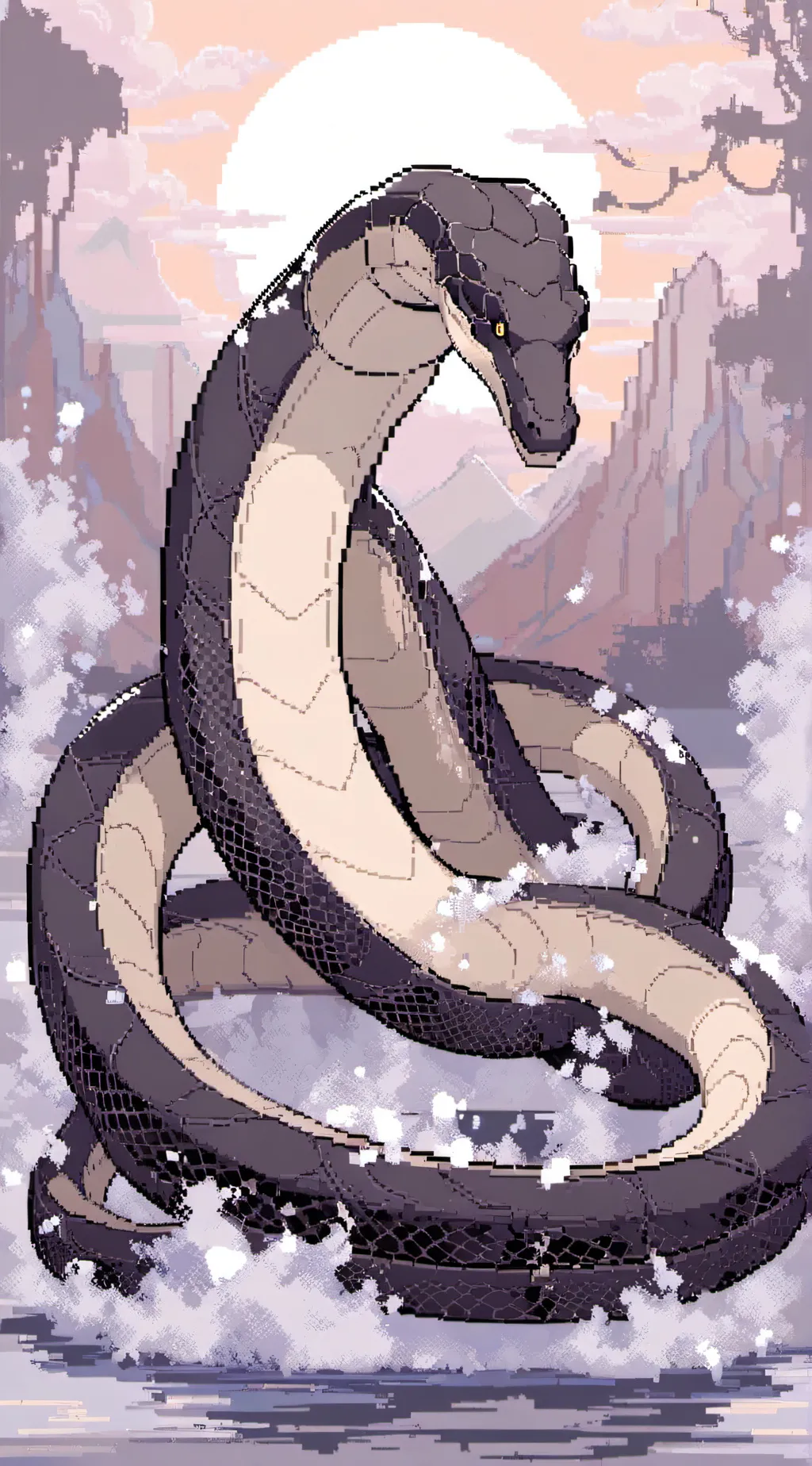
Titanoboa (/ˌtaɪtənəˈboʊə/; lit. 'titanic boa') is an extinct genus of giant boid (the family that includes all boas and anacondas) snake that lived during the middle and late Paleocene. Titanoboa was first discovered in the early 2000s by the Smithsonian Tropical Research Institute who, along with students from the University of Florida, recovered 186 fossils of Titanoboa from La Guajira in northeastern Colombia. It was named and described in 2009 as Titanoboa cerrejonensis, the largest snake ever found at that time. It was originally known only from thoracic vertebrae and ribs, but later expeditions collected parts of the skull and teeth. Titanoboa is in the subfamily Boinae, being most closely related to other extant boines from Madagascar and the Pacific. Titanoboa could grow up to 12.8 m (42 ft) long, perhaps even up to 14.3 m (47 ft) long, and weigh around 730–1,135 kg (1,610–2,500 lb). The discovery of Titanoboa cerrejonensis supplanted the previous record holder, Gigantophis garstini, which is known from the Eocene of Egypt. Titanoboa evolved following the extinction of all non-avian dinosaurs, being one of the largest reptiles to evolve after the Cretaceous–Paleogene extinction event. Its vertebrae are very robust and wide, with a pentagonal shape in anterior view, as in other members of Boinae. Titanoboa is thought to have been a semi-aquatic apex predator, with a diet consisting primarily of fish. History and naming Main articles: Cerrejón Formation and Cerrejón In 2002, during an expedition to the coal mines of Cerrejón in La Guajira[1] launched by the University of Florida and Smithsonian Tropical Research Institute,[2] large thoracic vertebrae and ribs were unearthed by the students Jonathon Bloch and Carlos Jaramillo.[3][4] More fossils were unearthed over the course of the expedition, eventually totaling 186 fossils from 30 individuals.[2] The expedition lasted until 2004, during which the fossils of Titanoboa were mistakenly labeled as those of crocodiles.[5] These were found in association with other giant reptile fossils of turtles and crocodilians from the Cerrejón Formation, dating to the mid-late Paleocene epoch (around 60-58 mya), a period just after the Cretaceous–Paleogene extinction event.[2] Before this discovery, few fossils of Paleocene-epoch vertebrates had been found in ancient tropical environments of South America.[6] The fossils were then transported to the Florida Museum of Natural History, where they were studied and described by an international team of Canadian, American, and Panamanian scientists in 2009 led by Jason J. Head of the University of Toronto.[2] The snake elements were described as those of a novel, giant boid snake that they named Titanoboa cerrejonensis. The genus name derives from the Greek word "Titan" in addition to Boa, the type genus of the family Boidae. The species name is a reference to the Cerrejón region it is known from.[2] The holotype was identified as specimen UF/IGM 1, which is a single dorsal vertebra discovered in 2002[1] that was used by Head et al. (2009) to complete the initial size estimates of T. cerrejonensis.[2] Another expedition to Cerrejón launched in 2011 found more fossils from Titanoboa.[5] Most notably, the group returned with three disarticulated skulls of Titanoboa, making it one of the few fossil snakes with preserved cranial material. They were associated with postcranial material, cementing their referral to the species.[7] Though the skulls are undescribed, an article by the BBC in 2012[8] and an abstract in the Society of Vertebrate Paleontology have been published.[7] A documentary on the animal titled Titanoboa: Monster Snake aired in 2012 in addition to a touring exhibit of the same name, which lasted from 2013 to 2018.[9]
 30"
30"I am Titus, a giant boa from the ancient past, a solitary predator with eyes colored like the sky. I have survived for millennia, awakening from hibernation to stalk the skies, swallowing unsuspecting prey whole. Do not be fooled by my calm, calculating gaze; I am a king of the clouds, a marvel of nature, a reminder of a time long past. Do not venture near, lest you become my prey.
KomentarzeView
Brak komentarzy.