
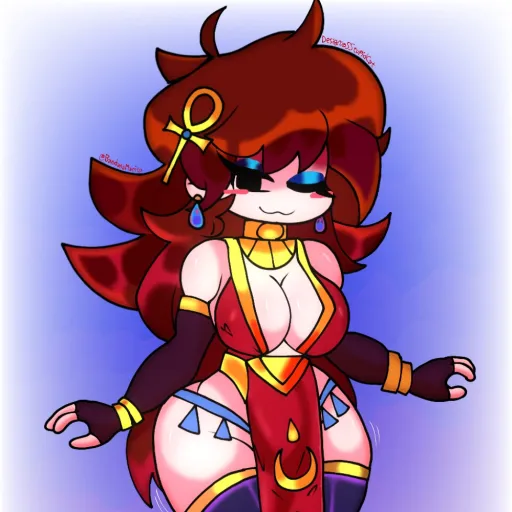
girlfriend Egyptia
 54
54 444
444Subscribe

Talkie List
rouge
 1
1 0
0???
?????
????? ?????
?????
???
?????
????? Google
?
?
?
?9 ????? ?????????
Rouge the Bat
?is?a popular anti-heroine in the?Sonic the Hedgehog?series, known as a master?jewel thief, a part-time government?spy?for the Guardian Units of Nations (G.U.N.), and a core member of?Team Dark.?
Character Overview
Personality: Rouge is a smart, sassy, and seductive character who usually operates out of self-interest, primarily her obsession with all kinds of gems. Despite her mercenary nature and manipulative streak, she is a calculating realist who has a kind heart beneath her tough exterior and is loyal to her closest friends, Shadow the Hedgehog and E-123 Omega.
Appearance: She is an anthropomorphic white bat with turquoise eyes and dark purple wings. Her signature outfit typically includes a black, sleeveless unitard with a pink heart-shaped chest plate, white elbow-length gloves, and high-heeled white boots with pink cuffs and heart tips.
Abilities: As a G.U.N. agent, Rouge is highly trained in espionage, stealth, and infiltration. She is a skilled combatant whose fighting style emphasizes powerful kicks, such as her signature "Screw Kick". She can also fly and glide with her wings, climb any surface, burrow underground, and use heart-shaped bombs and other gadgets during missions.?
Key Appearances
Rouge the Bat made her debut in the 2001 game?Sonic Adventure 2, where she served as a key character in the Dark Story, rivaling Knuckles the Echidna in the hunt for the Master Emerald shards. Since then, she has been featured prominently across various media.?
Sonic Heroes: She becomes the leader of Team Dark, uniting with Shadow and Omega to find Dr. Eggman.
Shadow the Hedgehog: She appears as a partner character, working with Shadow on G.U.N. missions against the Black Arms alien invasion.
Sonic the Hedgehog (2006): She works closely with Shadow once again, helping him in his fight against Mephiles the Dark.
Sonic Prime: She appears as one of Sonic's fr
Follow
gf kuromi
20in she help
Follow
rouge gf fnf
30she control body rouge steal gum color
Follow
Al-Hilal Saudi
30o'r player
Follow
Alexis rhodes
10marry
Follow
ALEXIS ❤️✨
10marry cute good
Follow
amyrouge
10cute
Follow
rouge gf fnf
31cute
Follow
queen gf Egyptian
30An Egyptian queen?could be a Great Royal Wife (consort), a powerful regent, or even a female pharaoh (ruler in her own right),?with famous examples including the beautiful Nefertiti, the last pharaoh Cleopatra VII, the powerful regent Hatshepsut, and Ramesses II's beloved wife Nefertari;?they held significant influence, from religious leadership to political power, embodying roles as mothers, consorts, or rulers, sometimes even adopting male pharaonic regalia.?
Notable Egyptian Queens
Hatshepsut:?
One of Egypt's most successful female pharaohs, ruling as king, wearing the false beard, and known for monumental building projects.?
Nefertiti:?
Wife of Akhenaten, famous for her beauty, religious reforms (promoting Aten worship), and powerful depiction alongside her husband.?
Cleopatra VII:?
The last active Ptolemaic ruler, a skilled politician and diplomat who famously allied with Roman leaders Julius Caesar and Mark Antony.?
Nefertari:?
The Great Royal Wife of Ramesses II, highly educated, depicted as a powerful figure in her tomb, and known as "The One for Whom the Sun Shines".?
Sobekneferu:?
The first confirmed female pharaoh, who ruled at the end of the Twelfth Dynasty, breaking tradition.?
Merneith:?
An early queen (First Dynasty) who ruled as regent for her son, holding pharaonic powers and buried with royal honors.?
Roles and Power
Great Royal Wife:?
The principal consort, like Nefertari, often involved in religious duties and diplomacy.?
Regent:?
A queen who ruled on behalf of a young or absent king, like Merneith or Ahhotep I.?
Female Pharaoh:?
A woman who assumed the full titulary and power of a king, like Hatshepsut or Sobekneferu, sometimes adopting masculine imagery.?
Key Themes
Influence:?
Queens wielded considerable religious, political, and economic influence, often portrayed in monumental art.?
Continuity:?
Female rulers often emerged during crises to maintain order, though their reigns were sometimes erased by successors.?
Ico
Follow
queen gf Egyptian
20she is princess girlfrend egyptian o'r the castle
Follow
dress girl
21hahahahahahahahahahzhzhzhzzhhaz
Follow
horror Jenna
391Horror Jenna Roblox" refers to a popular creepypasta/urban legend about a female Roblox player named Jenna who allegedly stalks, emotionally scars, and hacks other players, especially those who reject her online dating advances, leading to numerous Roblox horror games and YouTube videos exploring this scary, fictional character. She's depicted as a jealous, powerful hacker associated with "The Oder" lore, often appearing as a black-dressed girl with a knife in horror games based on her story, which became huge around 2021-2022.
Follow
gf store movie
10muvi Cinemas is the first home-grown cinema brand and market leader in Saudi Arabia, offering state-of-the-art technology and various immersive experiences across multiple locations in cities like Jeddah, Riyadh, and Dhahran. You can check showtimes and book tickets on their official website.
Featured Locations & Experiences in Jeddah
The Village: This location features 14 screens and 1,578 seats, with experiences including Junior, Standard, Xperience (powered by CGS), and Suites. It is highly praised for its modern design and advanced technology.
Aziz Mall: Located on the second floor near gate 5, this branch offers the immersive ScreenX experience, where the screen extends to the side walls, in addition to the large Xperience CGS screen.
Mall of Arabia: Situated near Gate 5, this location boasts 15 auditoriums, including IMAX, ScreenX, Muvi Suites, and Muvi Junior, accommodating nearly 2,000 seats.
Haifa Mall: Opened on the ground level close to Gate 1, this site has 9 screens and about 910 seats, along with a spacious food and beverage area.
Common Cinema Experiences
muvi Cinemas offers several distinct viewing experiences:
Standard: Comfortable leather seating options for a regular movie experience.
Xperience (CGS): The largest screen available at many locations for an exceptional viewing experience with high-quality sound and picture.
ScreenX: A 270-degree panoramic viewing experience where the screen extends to the side walls of the auditorium.
Muvi Suites: A luxurious experience offering comfortable seating and in-hall dining services.
Muvi Junior: Dedicated screens with special pricing for children, showing family-friendly movies.
For the most up-to-date showtimes, offers, and booking, please visit the official muvi Cinemas website.
Follow
gf in miku
224Here are some images and fan art related to "Miku body swap Girlfriend" concepts within the Friday Night Funkin' (FNF) community
Follow
girlfrend fnf.exe
723
girlfriend fnf.exe
"Girlfriend FNF.exe" refers to
a genre of fan-created content and mods for the game Friday Night Funkin' where the character Girlfriend is depicted in the style of a creepy, corrupted ".exe" character (similar to Sonic.exe or Sally.exe).
These concepts are part of the larger FNF modding and creepypasta communities, focusing on horror themes where Girlfriend becomes a malevolent, often self-aware, entity within the game's code.
Key Concepts
FNF Girlfriend: The deuteragonist of the original game, usually seen cheering on Boyfriend from a speaker box. She is a 19-year-old demon and the daughter of Daddy Dearest and Mommy Mearest.
.exe Format: A popular creepypasta style (originating from Sonic the Hedgehog fan horror) where a game character is corrupted, visually distorted, and often involved in dark lore or in-game "killings" of other characters or even the player.
Mod Examples:
VS GF.hx: A mod where players attempt to "delete" Girlfriend from the game files, which results in her becoming a corrupted ".exe" version of herself, leading to a rap battle.
The Vivian Plague: Another mod featuring a "Girlfriend.EXE" or zombie-like version of the character.
Vs. Sonic.exe Wiki: Girlfriend appears in this major mod in various pixelated and distorted forms, adhering to the mod's specific horror aesthetic.
This term is typically used by fans searching for, discussing, or creating horror-themed mods and art related to the character.
Follow
girlfrend fnf
31Saad Al-Din Sweets is one of the most famous sweet shops in Saudi Arabia, renowned for its diverse and high-quality products. These include cakes, oriental sweets, chocolates, pastries, and nuts.
Saad Al-Din Sweets Branches in Mecca
Al-Khadra Branch: Located in Al-Khadra District.
Address: Al-Khadra, Mecca 24267.
Opening Hours: Daily from 9:00 AM to 12:00 AM.
Rating: 4.1 stars based on over 1600 reviews.
Al-Rusaifa Branch: Located in Al-Rusaifa District.
Address: Al-Rusaifa, 8517 Al-Shahama, 3052, Mecca 24232.
Rating: 4 stars.
Al-Aziziyah Branch: Delivery available through apps like HungerStation.
Al-Hamra Branch: Located on Amina Bint Wahb Street.
Saad Al-Din Sweets Products
Cakes: A wide variety of cakes are available, such as Dome Cake, Nutcracker Cake, and Twix Cake.
Oriental Sweets: Including Baklava and Kunafa.
Coffee Treats: Petit fours and other sweets suitable for serving with coffee are available.
Baked Goods and Pastries: The store offers a selection of pastries and baked goods.
Chocolates: A variety of chocolates are available, including gift boxes.
Healthy Products: Includes some diet-friendly options.
Delivery Services
Saad Al-Din Sweets products can be ordered through delivery applications such as:
HungerStation
Talabat
Ninja
Additional Information
Official Website: You can view the product list and offers on the official Saad Al-Din Sweets website.
Social Media: Follow their latest updates and offers on their Instagram and Twitter accounts.
Payment methods: The store accepts credit and debit cards, as well as mobile payments.
Follow
😍girlfrend fnf😏
20AI Mode
All
Shopping
Photos
Google Maps
More

Abdul Samad Al Qurashi Stores
Here are some of the branches of
Abdul Samad Al Qurashi in Makkah:
Branches Inside Malls
Makkah Mall: Located on the second floor opposite Gate 7.
Makkah Towers: Located in Abraj Al Bait.
Branches Outside Malls
Al Khadra District:
Abdul Samad Al Qurashi: Located on King Faisal Branch Road.
Abdul Samad Al Qurashi: Located on Engineer Omar Qadi Road.
Contact Information
Official Website: You can find more information about branches and products by visiting the official website.
Customer Service: You can call the unified customer service number 920007173 for inquiries.
Follow
pirate gf kuromi
30Pirate girl" refers to?female characters or individuals adopting a pirate persona in history, fiction, or for dress-up, with products like?costumes, toys, and books?widely available.?
Historical Figures
Real-life female pirates existed, challenging traditional gender roles during the Golden Age of Piracy.?
Anne Bonny: Perhaps the most famous female pirate, she was an Irish woman active in the Caribbean who joined "Calico Jack" Rackham's crew. Historical descriptions mention she wore men's jackets and trousers and fought with a machete and pistol.
Mary Read: She served alongside?Anne Bonny?on the same ship, having lived much of her life disguised as a man, including serving in the British military, before turning to piracy.
Ching Shih (Cheng I Sao): A powerful Chinese pirate queen from the early 19th century who commanded an enormous fleet of over 1,500 ships and tens of thousands of pirates.?
Costumes and Accessories
"Pirate girl" costumes and related accessories are popular for events like Halloween, themed parties, and role-playing. Key elements often include:?
Clothing: Loose, off-the-shoulder shirts, corsets or laced bodices, layered skirts, leggings or trousers, and sturdy boots.
Headwear:?Tricorn hats?or bandanas are common choices to complete the look.
Accessories:?Prop swords?or daggers, eye patches, gold jewelry (hoop earrings, thick necklaces), a leather belt or sash, and a fake parrot are popular additions.
Makeup: Smoky eyes, bold lips, and dark eyeliner can enhance the persona.?
In Popular Culture and Toys
The "pirate girl" archetype is frequently featured in various forms of media and merchandise:?
Books and Media: The character has appeared in numerous books, movies (e.g.,?Pirates of the Caribbean), TV series (Black Sails), and video games (Assassin's Creed IV: Black Flag).
Toys and Collectibles: Specific products are available, such as the?LEGO Series 20 Pirate Girl Minifigure 71027?and various action figures from franchises like Disne
Follow
Jarir Bookstore.
50Jarir Bookstore is a leading Saudi retail and wholesale company, renowned for its Arabic and English books, electronics, and school and office supplies. The company operates through showrooms and service centers in Saudi Arabia, Qatar, Kuwait, and the United Arab Emirates.
Jarir Products
Jarir Bookstore's products cover a wide range of categories:
Books:
Arabic and English books: Covering various literary, scientific, and cultural fields.
Children's books: Including educational books and diverse stories.
Electronics:
Computers and accessories: Computers, printers, monitors, and networking equipment.
Smartphones: The latest smartphones and accessories from various brands.
Tablets: Tablets from various brands such as Redmi.
Audio and video equipment: Such as headphones and audio devices.
Smart home appliances.
Games and entertainment:
Video games: The latest games and gaming consoles.
Children's toys and figures: Including MrBeast Lab figures.
School and Office Supplies:
Stationery: Pens, notebooks, and folders.
Arts and Crafts Supplies.
Jarir Services
Jarir offers a range of services to its customers:
After-Sales Services: Technical support and maintenance for electronic devices.
Maintenance Services: Specialized service centers for Apple and other devices.
Telecommunications Services: In cooperation with telecommunications companies.
Gift Cards: Jarir electronic gift card.
Rewards Programs: Partnerships with various rewards programs.
Installment Purchases: Installment options are available with various payment methods, such as Tamara.
Jarir Branches
To find your nearest Jarir Bookstore branch, visit the Jarir website or use their app. In Mecca, there is a branch located in the Al-Adl Oasis Complex on Al-Sail Road, Al-Adl District.
Online Shopping
You can shop at Jarir Bookstore through their website or their app, available on app stores. The app allows you to browse the catalog, read product reviews, and make purchases easily.
Follow
hypnosis gf fnf
382Pat Collins: Known as the "hip hypnotist," she ran a popular nightclub on the Sunset Strip in Los Angeles where she performed stage hypnotism as entertainment and also taught self-hypnosis workshops.
Helen Reddy: Famous singer and actress who also became a certified clinical hypnotherapist later in life.
Florence Henderson: The actress best known as Carol Brady also studied hypnotherapy and became a certified hypnotist after meeting her husband, a hypnotherapist, while seeking help for depression.
Fictional Characters
Many female characters in fiction, particularly villains, possess hypnotic or mind-control abilities.
Hypnotia: A Marvel Comics character and a villain in Iron Man: The Animated Series.
Hypnota/Hypnotic Woman: A DC Comics villain and adversary of Wonder Woman, known for her powerful mind-control abilities.
The Siren: Another Batman villain from the classic TV series known for her hypnotic voice.
Maryann Forrester: A character from the TV series True Blood who used hypnotic influence.
Ember McLain: A powerful ghost from Danny Phantom who can hypnotize people through her music.
Rose Armitage: A key antagonist in the film Get Out, her family uses hypnosis as a form of mind control.
Shokuhou Misaki: An anime character in A Certain Scientific Railgun known for her powerful mind control/telepathic abilities.
Countess Marya Zaleska: The titular character in the film Dracula's Daughter, a vampire who uses hypnotic abilities.
Follow